
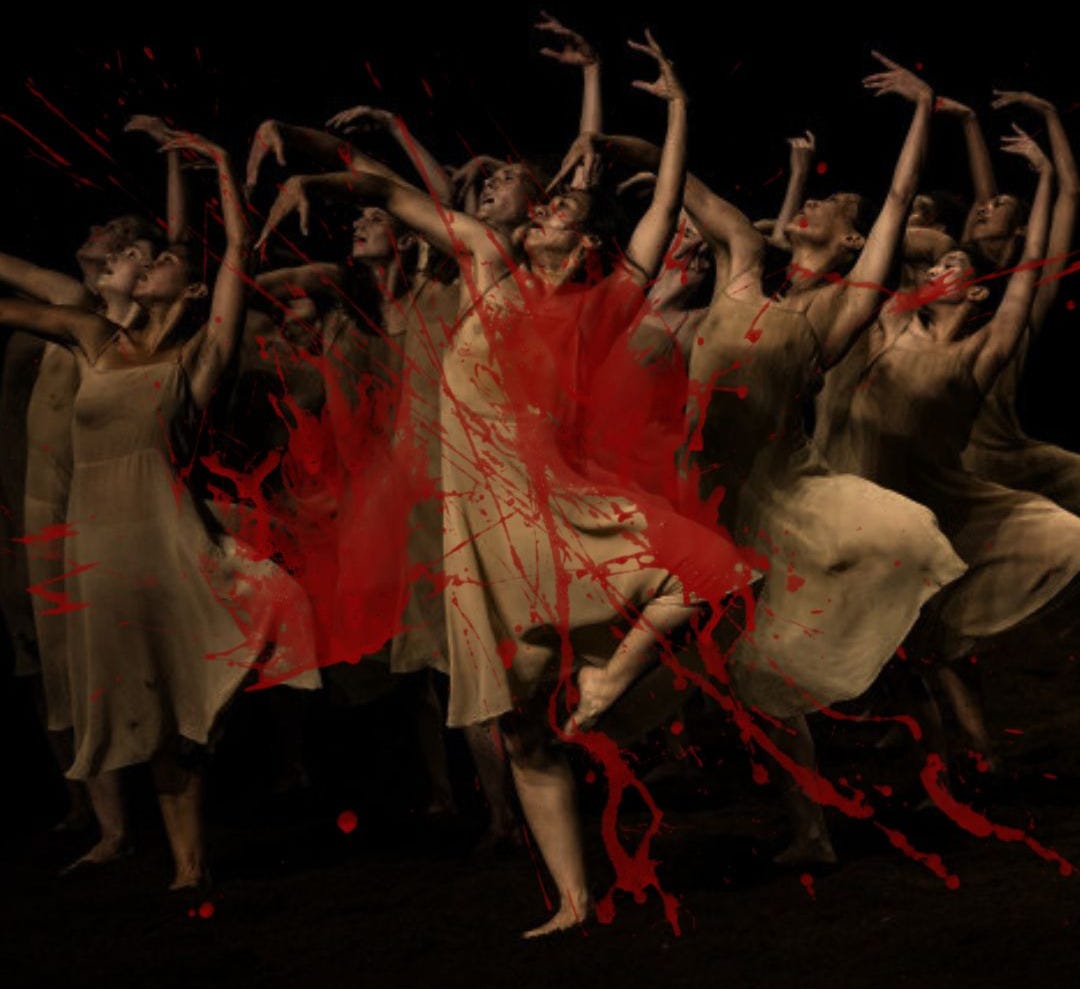
It is now three days since the Dancing Man came.
Mr. Cossart is gone. Nobody knows what happened to him. He left a letter on his desk, quite mysterious: He who comes after is greater than I, the string of whose shoe I’m not worthy to tie. He always was a bad poet. One of the girls said it was from Scripture. I don’t know anything about that. What I do know is, my arms and my legs ache, and I can’t remember the last time we had something to eat, and sleeping feels like something that used to happen to another person a long time ago, but never to me. I only know the impression of sleep. I only know that sometimes I am on the stage, and sometimes I am not. When I’m on the stage, he is there, always. And when I am not, I believe he is looking at me, in the parlour behind the stage, watching from the long yellow curtains, or even hidden, impossibly, in some crevice in the ceiling. I have felt little bits of plaster drop down on my nose. Yes, he must be up there. He makes himself to be a shadow. He could be crouching up there, and any moment he will leap down, and grasp my hands, and make me to dance again.
It’s a new routine. It’s the latest thing. It will be the sensation of the century. I seem to remember Mr. Cossart saying all this and more, many years ago. But that cannot be. I am not many years old myself. Marie is the oldest of us all, and she is only sixteen. Marie said it would be all right. But she said this, too, back in the old days, when the men in black coats with long gleaming moustaches used to sit in the parlour and talk to Mr. Cossart about that pretty little one over there, that one with the plump rosy face, that one with the cloud of auburn hair. She said it was all right, and then I would find her crying afterwards. And then she would say, don’t bother, don’t pay me any mind, and she’d get up and scrub her face in the washbasin, and the next day she would act as though nothing had happened, and she would be laughing and dancing again.
I used to see him out on the street. I swear it is the same man. He was old and wizened and ugly then. He was always dancing between the crooked lamppost on the Rue de la Croix Rouge and the lane with the trees on one side and the river on the other, where the broughams clatter down to the palace. There was no music. Never any music. Whatever music there was existed only in his little withered brown head, his shrunken little brain. His shoulders would twitch. His legs would rattle. Some of the girls, I remember, made fun of him. Most of us simply ignored him. He would dance up to the café with the dead geraniums in the window and down again. He would leap over the overflowing gutter and land with a splash in the muck. He didn’t hurt anybody. He would simply dance. Marie once threw a sou in his cap. I told her not to; I tried to catch her hand. She laughed, and said she had money. I remember. There was a golden ribbon of brandy lacing her breath that day. Mr. Cossart had brandy on his desk. None of the other girls had any money, except when the gentlemen callers came.
We are starting to dance again. Gone are our stockings, our long tulle skirts. We dance in our slips, and our bare feet. The stage is dark. The theatre is empty. The Dancing Man is here. He is not the old shrivelled man in the tattered coat that the passersby used to jeer at on the street, and even the other beggars would avoid. He is very tall now, taller even than Mr. Cossart. I remember when he first came to the opera. It was the day after Marie had given him the sou. He stood out by the back entrance in the alley, and it was the only time I have ever seen him still. He didn’t move at all. There was no shuffling, no leaping. One of the gentleman callers in a tall silk hat jostled him. Another sneered at him through his lorgnette. He didn’t seem to notice. I stood there, watching him, for a long time. And then Mr. Cossart was gone in the morning, with a note saying we were to have a new teacher, and learn a new dance.
Felicity told me a curious thing. She sleeps in the bed next to mine. She said, you are a little fox, and I am going to be the badger. I told her not to be silly. She said, Claudette is a snake. Adele and Josefina will be a pair of kestrels. I told her there is no such dance. I have never heard of this story before. And besides, even if there were such a thing, you would never be a badger. You would be the Fairy Princess. You always are. And then she got up in her nightdress, and began to dance. And I saw it. I saw the long claws, and the striped muzzle. I saw her move under the beds in the sleek, sinewy manner of a badger seeking out its prey. She slunk all the way down to the parlour. I followed her. She was sniffing the air. It was very late, or very early, almost three o’clock. Felicity, I said, if you don’t go back to bed now, you’ll have no strength for your new routine in the morning.
We had reached the parlour door. Claudette was a snake, as promised, swaying and hissing, her hair flung about her shoulders like the venomous hood of a cobra. Adele and Josefina were purring in the shadows. I felt a hand touch my own. He was there: the Dancing Man. I don’t know what he was meant to be. Maybe a panther. His movements were all like velvet. He made a chirping sound in his throat. And I knew then, suddenly, what it was that Felicity was talking about. Yes, yes, I was a fox—it all made sense now. I felt the warm black earth of my burrow about me. My nostrils filled with the scent of the forest. Beneath my paws was the crinkle of moss. It was like being a little girl again, in the days before my father’s lungs filled with blood, and my mother sent me away to the city. We were in the woodlands now. We were frolicking through the trees. The Dancing Man said, give me a little yelp. That’s right. Now, the hunters are after you. There is the noise of the bugle. Run—run—run. The hounds are coming. You are cornered; you must turn and face them. Let me see your tail. Now a snarl. One of the hunters is raising his musket. His hound is at our throat. What do you do? What do you do?
I remember the moonlight streaming in from the parlour windows. Strange, I thought, because the curtains were always closed. I remember seeing a silk hat in the closet. Golden glasses left on the table, with one of the lenses crushed. The brandy had spilled out onto the carpet. We all heard the music; we felt the rhythm in our feet. I saw him for a moment, the hunter, in his sleek black boots and his red riding coat. I saw his face whiten with shock. He hadn’t expected the little fox to nip him. He was off his horse now, he was helpless, alone. His musket had jammed. The hound had run off in terror.
I was on top of him, and I was going for his throat.
‘It is only fitting that the little rats are built of steel, those frail ambitious girls, fervent for luxury, nut-eaters who become apple-eaters; forged for the fight, they pass through life, shrugging their shoulders and saying, “Men? Oh, come now! They’re no match for me!’” L’Illustration 1881 (Anonymous)